Webinar Notes: Community-Based Research

I’ve attended a few webinars lately where I’ve taken some notes during the session with the intention of posting them here on my blog, and then not quite gotten around to adding in the links I wanted to and actually posting them. But I’ve decided to correct that! Here’s the first of a few postings like this.

Perception vs. Reality in HIV Community-Based Research (CBR)

webinar held by: SFU Faculty of Health Sciences
date: 6 February 2014
presenter: Terry Howard, MSc, PPH

  • CBR ” a form of research in which principles of community involvement and collaboration are applied using scientifically accepted research methods”
  • CIHR defintion: “Community-based research (CBR) is a collaborative approach to research that equitably involves all partners in the research process and recognizes the unique strengths that each brings. CBR begins with a research topic of importance to the community with the aim of combining knowledge and action for social change to improve community health and eliminate health disparities. CBR brings researchers together with members of the community to: identify the issues; collect, analyze and interpret the data; and decide how to use the results to inform policy, change practice and improve conditions in the community.”
  • engage communities at *all* stages of research (i.e., from the creation of the research question through to disseminating research results)
  • often, community-based research is often considered “anecdotal”, but doesn’t take into account the different ways of gathering evidence that isn’t the same as the “scientific” framework

 Community-engaged research continuum

  • investigator-driven research – less community involvement
    • investigator comes to community with a research question
  • community-placed research
  • community-based research
  • community-based participatory research
  • community-driven research – complete community involvement
    • community comes up with question, writes grant application, etc.

Theory vs. Practice

  • often not practical for community members to write a grant application, which is going to be reviewed by researchers who will expect a certain way of writing, certain language, etc.
  • CIHR requirements to become “qualified” to hold funds is quite onerous for a community agency – so often the institution holds the funds, though it requires a good relationship, clear roles/responsibilities, clear expectation of all the partners so that the community agency can trust that it will get control of funds that it needs to do the work
  • make use of the talents of both sides (academics have strengths in grant writing, academic institutions can hold research funds, community brings relevancy and participation)
  • there needs to be something in it for the community – if there’s no benefit to them, why would they be involved?
  • data control is an important issue – who owns & controls the data and how results are communicated
  • power dynamics – especially when there is one community member on a committee with many academics – need to work to even the playing field
  • “community-based research is messy” – things don’t go as smoothly or as per the proposed timeline
  • dissemination – academics tend to want to publish, community members tend to want to present and use findings for the benefit of the community – each side needs to see the value of the different ways of disseminating
  • budget to include community members as researchers
  • GIPA = greater involvement of people with living HIV/AIDS
  • MEPA = meaningful engagement of people living with HIV/AIDS
  • in response to “drive by researchers” – people who came and asked questions/collected data on a community and then left without providing anything for the community
  • “nothing about us without us”
  • used to be more about having a token community member on a committee who they would update once in a while; now moved to where community members are more meaningfully engaged (e.g., community coming up with research questions, community members trained to conducted the research)
  • there should be benefits to both sides of the partnership
  • can be useful to do process evaluation along the way – e.g., community members keep ethnographic notes and tell researchers how things are going
Posted in research, webinar notes | Tagged , , | Leave a comment

Customer Service – You Are Doing It Wrong!

As I’ve been taking this Digital Marketing class over these past six weeks, I’ve started to pay attention to my experiences as a customer in a different way. Instead of being just annoyed/delighted by the bad/good service that I receive as a customer, I’ve started to think things like “How does this tactic tie to their overall strategy?” and “Don’t they know that this is going to harm their brand?” I’ve had two particularly bad customer services experiences recently that I’d like to present here – one that seems to be based on the use of bad systems/lack of competence at digital marketing and the other one that demonstrated the company’s lack of understanding of the way that digital works.

Trying to Buy A Coat Online From Marks & Spencer 

I was in Europe this past August and fell in love with a coat at Marks & Spencer. Sadly, they didn’t have my size in this coat either in London or in Dublin (the two places I went with M&S stores), so I came home empty handed. However, upon returning to Canada, my mother discovered that not only can we order things online from M&S, but they have *free* shipping to Canada! And thus we started watching the website to see if they would ever have that coat in my size again – which they finally did in October!

Idea #1: Why not have a “tell me when this item is in stock again” option in your online store rather than expecting a customer to continually return to your website to check if the item is in stock? Expecting the customer to remember to return risks them forgetting about it entirely, but if your system notified them when the product was back in stock, it would draw them back to your site.

So I ordered the coat on Oct 10 and when it hadn’t arrived by the day their online ordering system said it should have arrived (Oct 21), I emailed to inquire about. Their reply:

Although your estimated delivery date was Monday, 21 October, please allow a further 7 days for your package to reach you.

With international orders under £80 in value and 2kg in weight we use a standard delivery service. This can take longer than with an express courier and parcels can’t be tracked.

If you haven’t received your order by the timescale advised please contact us again for us to investigate further.

Idea #2: Your online ordering system should give the correct information about when and how a package will arrive. Why set the customer’s expectation that it will arrive on a date that is one week earlier than you think it’s going to get there? The system knows from the delivery address that it’s an overseas shipment, so it shouldn’t be hard to give the accurate date. Similarly, their online ordering system does provide a tracking number, but when you click on it, it takes you to the Royal Mail website where you are told that the tracking number is not valid. Again, the system has my mailing address and knows it’s an international order, so why not have the online ordering system tell me that, instead of giving me an invalid tracking number, which will only serve to irritate me?

Three days  later, much to my surprise, I received an email saying my order had been refunded:

We’ve processed your refund in the amount of £79.00 for your Order  xxx-xxxxxxx-xxxxxx.

This refund is for the following item(s):

Item:Petite Pure Cotton Double Breasted Belted Trench Coat with Stormwear™
Quantity: 1
ASIN: B00DDCKT26
Reason for refund: Customer return

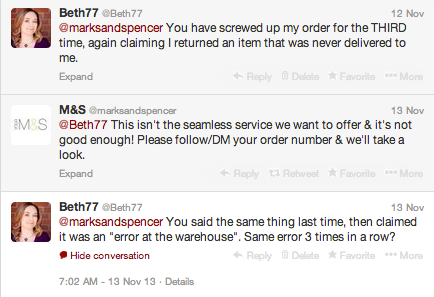
Customer return? I hadn’t received it! Then I started to wonder if it was because I’d asked for it to be shipped to the office building where I work 1Don’t get me started on the customer service issues related to the courier business!. Perhaps the main reception desk turned it away instead of notifying me that it has arrived? So I reordered the package, this time to my home address (though I know I’m not home during the day to receive it, I figured the delivery person would leave a notice and I could go pick it up).  But then it happened again: my money was refunded due to “Customer Return”, despite the fact that it has never been delivered to me! And thus began a back-and-forth of emails and tweets between Marks & Spencer and I that can only be described as incredibly frustrating. Some of the “highlights” included:

  • They asked me to direct message (DM) them on Twitter with my order number so they could look into it, but they weren’t following me on Twitter. Whoever is running their Twitter account really should know something as basic as the fact that I can’t DM them if they aren’t following me.
  • The only way to email M&S is with their online ordering system’s contact form. They reply to you via regular email using a “no-reply” email address, meaning that if you want to reply to their message (a) you have to log back into their site and send a message through their contact form, and (b) the person who receives that email doesn’t actually know what you are responding to! In a way, but having this set up, they are using email to broadcast a message to you, rather than engaging you in a conversation. That’s a sure fire way to annoy  customers who are trying to get a problem sorted out. Combine this with the fact that they took a long time to respond, which gave me more time to be annoyed, so that I ended up taking that annoyance out to Twitter in the hopes of getting a response.
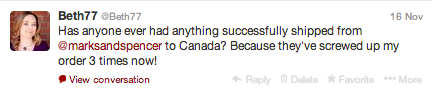

M&S tweet 4

M$&S tweet 3

M&S tweet 2

Because of their poor system for tracking email “conversations” (which I put in quotation marks since it was really me sending emails and getting a response from a different person each time), I ended up with completely contradictory messages, such as:

  • The order “probably” got turned back at customs 2Two different reps told me this, though couldn’t very that this actually ever happened. and I should ask customs about my package 3They also told me about one point that they weren’t responsible for my country’s customs regulation (as if I thought they were) and perhaps I should call customs to see if they have a ban on importing coats from England.. When I pointed out the ludicrousness  of their suggestion (Did they really expect me to call up Canada Customs and say “Hi, it’s Beth! Did you get a package for me from England? I have no information about this package other than my name, because they don’t give valid tracking information!”?), they completely ignored it.
  • The order couldn’t be delivered due to an error at their warehouse, said an email from yet another rep, and they were going to give me a £10 store credit to make it up to me. When I asked what good a £10 credit is when they aren’t able to ship me anything, the next customer service rep who replied after that said “The £10 credit we gave to you as a gesture of goodwill, if you want to place any other order you can use that amount for that order.” Which (a) has the tone of “how dare you be so ungrateful when we are giving you money!” and (b) completely ignores my point that the credit is hollow if I’m unable to use it.
  • Yet another rep then emailed to confirm that it was, in fact, an error at their warehouse and not a customs issue. And granted me a second £10 credit and suggested I re-order it a third time. Interestingly, this time the reply included an email address to which I could reply 4I guess I got “escalated” as a customer who won’t stop bitching?. Which I did and after another email with that rep, I re-ordered for a third time. And can you guess what happened?

Indeed – the exact same “error at the warehouse” happened a third time! At this point, I ordinarily would have given up, but I was actually rather enthralled by the multitude of ways they were screwing this up and wanted to see how long this would go on for, so I asked them to explain exactly how they would ensure they wouldn’t screw it up again and what company they used to ship to Canada 5The latter being something I’d asked several times throughout this time without ever getting an answer., got some answers to those questions, and then re-ordered it again, this time with a £25 credit to my account. Much to my surprise, just three days later, I got a message from a courier company that a package had arrived for me from Marks & Spencer!

And then the very next day I received this email from a manager:

Further to your contact about your recent order. I am sorry to hear about the problems you gave experienced. I can understand the disappointment and upset caused.

This is not up to our usual standard of service and we are certainly looking into it. Whenever there is a problem like this, we are always committed to putting it right and preventing it from happening again.

The details of this issue are currently being investigated at our distribution centre and I know they are working hard to resolve this.

I have taken the opportunity to reorder the coat with no charges and will monitor the dispatch process to check there is no further problem with the delivery. I have sent email confirmation of the order summery to you.

Thank you once again for taking the time to contact me; we rely on our customer feedback to improve the service that we offer.

Are you kidding me? I was about to reply that I’d already bought the coat and they’d finally found a way to ship it to me so there was no need for a second one, but then I realized that I hadn’t yet received the package and given their lack of competence at this whole shipping process, I had little faith that the package would actually contain the right product! So I didn’t say anything and, as it turns out, they did ship me the right product in the right size and the right colour. So now, I’m the owner of not one but two identical versions of this lovely coat – a fall coat, mind you, and it’s now winter time.

The whole process – which really should have taken only 3 days from ordering until it was delivered 6Which is how long it took once they finally figured out how to ship it. had taken 42 days, resulted in significant frustration to a customer, some bad sentiment about their brand on Twitter, and cost them £104 7The £25 credit on the coat I ordered plus the second coat they shipped me for free, a £79 value. plus the cost of international shipping for two packages.

Idea #3: Use technology to allow your customer service reps to actually converse with customers instead of impeding conversation. Employ a better customer relationship management system so that whoever is interacting with the customer will know the history of the conversation. That alone could have saved them sending me a second coat – as they could have seen that I’d been given a £25 credit and told to re-order the coat, which I had done.

Black Bond Books Sees The Online World Very Narrowly

The M&S story had a happy ending – it really is a fantastic coat! – but the same cannot be said about my recent experience with Black Bond Books, a local chain of bookstores. I won’t bore you with re-telling all the details of the story 8As I did in excruciating detail with my M&S story!- but you can read the gist of it in the screenshots below.

This was a comment from the company president on a thread on the Black Bond Books Facebook page about the event where she had been incredible rude to me (i.e., a customer) 9I didn’t realize at the time that she was the company president – but she had a nametag on, so when I saw the comment by her on the FB page, I Google her and found out that she wasn’t the store manager, as I had originally assumed!:

Black Bond Books 1So I wrote this comment:
Black Bond Books 2

Her reply, followed by my reply to her:
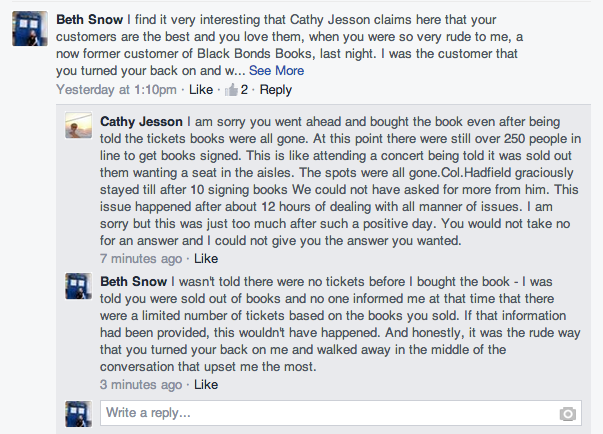
Black Bond Books 3

The interesting part for our purposes here is how Ms. Jesson reacted to the online criticism of her customer service. She responded to my first message (a full day *after* I posted them) and then when I replied to call her out on the fact that she was not telling the truth about what happened and that the real criticism was actually her rudeness… she deleted the conversation off of their Facebook wall.

Now, one of the things we’ve been learning in our Digital Marketing is that the part of the digital world that a given brand controls is just a tiny speck compared to all the conversations that are going on out there. So sure, Ms. Jesson can delete my criticism from her company’s little Facebook wall, but that is tantamount to sticking her head in the sand. Because aside from the fact that my criticism was there for an entire day – which is an eternity in digital land – she can’t delete my tweets, my Facebook postings, any blog postings I write, my friends’ tweets and Facebook postings and the ensuing conversations had ther (of which there were several), the screenshot of the deleted postings that I put onto Flickr… well, you get the point. It’s a big wide digital world out there and the plethora of online platforms out there give your customers a way to amplify their word of mouth.

Idea #4: Don’t be a jerk to your customers. You never know how many Twitter follower they might have.

Footnotes

Footnotes
1 Don’t get me started on the customer service issues related to the courier business!
2 Two different reps told me this, though couldn’t very that this actually ever happened.
3 They also told me about one point that they weren’t responsible for my country’s customs regulation (as if I thought they were) and perhaps I should call customs to see if they have a ban on importing coats from England.
4 I guess I got “escalated” as a customer who won’t stop bitching?
5 The latter being something I’d asked several times throughout this time without ever getting an answer.
6 Which is how long it took once they finally figured out how to ship it.
7 The £25 credit on the coat I ordered plus the second coat they shipped me for free, a £79 value.
8 As I did in excruciating detail with my M&S story!
9 I didn’t realize at the time that she was the company president – but she had a nametag on, so when I saw the comment by her on the FB page, I Google her and found out that she wasn’t the store manager, as I had originally assumed!
Posted in bama513, marketing | Leave a comment

Urban Native Magazine – Digital Storytelling and Community Building

I recently read about Urban Native Magazine in the Financial Post. It was started by Lisa Charleyboy, a storyteller, blogger and tweeter turned magazine creator. From the Post article:

Identified as an aboriginal millennial to watch by Huffington Post, it’s clear Ms. Charleyboy understands how to use social media — a fashion writer and editor she was named one of Canada’s top fashion bloggers, as well as one of Toronto’s top tweeters. Now, she plans to use the medium to inform her latest venture, Urban Native Magazine, an online publication with a clear mission: To be the go-to destination for current articles on Indigenous fashion, art, culture, entertainment, lifestyle, news and business.

The magazine, aimed at 15 to 35 year-old aboriginal people in North America, will use editorial content and social media streams such as Facebook, Twitter, Tumblr and Instagram to create positive change for aboriginal youth by getting them talking about social, political and pop culture issues, breaking down stereotypes and sharing success stories.

What I really like about this story is the positivity. Ms. Charleyboy is quoted in the article as saying “As a teenager and young woman, I did not see positive reflections in mainstream media of Indigenous and native people in a current and modern context.” And so she did something about it. She created a blog – which has now turned into this magazine – to highlight the success stories and provide positive role models that she didn’t see when she was younger.

A similar quote in the article is from JP Gladu, president and chief executive of the Canadian Council for Aboriginal Business (CCAB): “Certainly there are challenges, but if you are a young aboriginal person and all you read in the media is how your communities are failing, what seed will that plant in your psyche? On the other hand, if you start to see success stories of people just like you adding value to society, that’s where you start to develop pride. Positive energy breeds positive energy.”

In my work in the health care sector I’ve had the opportunity to work with our Aboriginal Health team and had the honour of attending some ceremonies and meetings in many First Nations communities in our region. Mr. Gladu’s comment made me reflect on the fact that, in the health field, we often hear about the disparities in health status experienced by Aboriginal people compared to non-Aboriginal people – for a very broad range of health indicators, Aboriginal people have a significantly worse health outcomes. And of course it’s important to identify and address these inequities so we can work together to correct the injustices. But equally important is to look at what’s working and to highlight those success stories. Through my work with our Aboriginal Health team, I’ve seen some fantastic things happening in many communities and it’s so awesome to see Urban Native Magazine doing that work on a large scale, engaging youth in their culture and providing them with positive role models.

The other aspect of this story – which relates to the digital marketing theme of my blog at the moment – is the integration of a variety of social media platforms – blogging, Facebook, Twitter, Instagram – with a focus on conversation and building community. As the title of the Financial Post article (“An aboriginal storyteller for the digital generation: Entrepreneur aims to get native culture in front of today’s youth”) highlights, storytelling is an important part of Aboriginal culture and digital marketing tools allow people to tell stories in new ways and reach new audiences. I’ll certainly be keeping my eye on this magazine to see what new and exciting things they are doing!

For more:

Posted in bama513, Cool Things | Tagged , , , , , | 2 Comments

Social Media and Social Determinants of Health

Given my interest in Public Health and the social determinants of health, and the fact that I’m currently taking a class on digital marketing, including social media, the National Collaborating Centre for Determinants of Health (NCCDH) 1I had initially put the incorrect National Collaborating Centre here, but fixed it on 2 December 2013. Thanks for bringing this to my attention, Pemma! recent webinar called “Public health, social media, and the social determinants of health” caught my attention.

social media & SDOH

Social determinants of health (SDoH), much discussed among practitioners and academics in the field of Public Health, refer to the those things outside of the health care system, that affect people’s health. These determinants – things like povery, education, gender, ethnicity, employment, and the communities we live in – affect our health a lot more than the healthcare system does. In fact, they are estimated to account for about ~75% of our health, whereas healthcare only accounts for about ~25%. So it makes sense that if we want to have a better understanding of what’s affecting people’s lives, we have to understand what their lives are like. And given that so many people are on social media, it makes sense to use these tools to reach people where they are at. This can be in terms of both reaching out to people to provide information and resources that might help them (broadcasting, but in a targeted way), but also to *listen* to what people are talking about – what’s important to them and what’s affecting them. And, to not only talk and to not only listen, but to engage in meaningful conversation with people.

A lot of the things that were discussed on the webinar resonated with what we’ve been discussing in class (the full set of notes that I took are after the jump). Here are my key takeaways (many of which are things we talked about in class, but it was interesting to see them in the context of social marketing for health) from this webinar:

  • We often spend a lot of time “preaching to the choir”. Social media gives us a chance to listen to the conversations of groups who we don’t traditionally talk to – we can learn from them and engage in dialogue to better understand their side of things and perhaps to find where we have common ground.
  • Think about *why* you want to engage – what do you hope to achieve – and based on the objective, ask *what* are the best tools to achieve those objectives.
  • How can you add value (e.g., interpretation, analysis, and/or context), rather than just being part of the echo chamber?
  • Think about what your target audience is looking forward – what words would they search for when they are looking for what you have to offer. They probably won’t search for “locations of Public Health unit”, but they might search for things like “what vaccines should my kids get?” or “need help with breastfeeding”. You need to make sure that you make yourself findable in the ways that people will search for the things you have to offer.

I also really liked this video that one presenter shared from his organization, Upstream:

It’s catchy with a clear message, not too long (as people tend not to want to sit through very long videos), easy to share (because it’s on YouTube) and calls you to action – go to their website to learn more and get involved.

A few more links:

Continue reading

Footnotes

Footnotes
1 I had initially put the incorrect National Collaborating Centre here, but fixed it on 2 December 2013. Thanks for bringing this to my attention, Pemma!
Posted in bama513, Public Health | Tagged , , , | 5 Comments

Dr. Dan Gillis Talks “Farm To Fork”

I enjoyed doing that last interview so much, I decided to do another! This time, I interviewed Dr. Dan Gillis, an Assistant Professor and Statistician at the University of Guelph who has had some  great success getting a project off the group using a number of digital marketing tools. I spoke with him the other day to learn more about his project – Farm To Fork – and the digital marketing tools he used to launch it.

The Project: Farm To Fork

Farm To Fork was a project that arose from an idea that Dan and his friend Danny Williamson had, which soon became a class project for one of the classes that Dan was teaching. From the Farm To Fork blog:

The Farm To Fork project began with a simple question: in a culture that wastes nearly 40% of all food produced, how do we connect the people who have fresh food to give to those who need it most?

The Farm To Fork website is part of the solution. Designed to facilitate communication between donors and emergency food service providers, the website aims to increase the quality and quantity of fresh food donated to local food banks and food pantries.

How is this accomplished? It’s as simple as an email delivered the day you typically go shopping – letting you know what is needed, and where it is needed most.

Be part of a better solution. Be part of Farm To Fork.

Basically, the idea is that the Farm To Fork site connects people who have food to donate to the food banks and food pantries (also known as “emergency food providers”), making it easier to let people know what specific types of foods they need. Because food banks and food pantries often have less healthy foods donated, but more healthy foods would be so much better.

As we’ve learned in the MBA program, this is a project is a classic example of the network effect: the more people in this network, the more valuable it will be. If there are more emergency food providers in the network, it will be more enticing for people who are interested in donating to join and vice versa – having more donors in the network will make it more valuable to the emergency food providers. So it’s important to be able to attract both type of “clients”: the emergency food providers and the donors (which can be individuals, farmers, community gardeners – anyone who wants to donate food!).  So how have they gone about attracting them?

Getting People On Board For The Project Using Digital Marketing Tools

social-media-puzzleFor emergency food providers, they started with good old fashioned word-of-mouth to build the initial base when they were developing the project, but once they launched and the Twitter account was created, emergency food providers from surrounding cities and towns soon started contacting them, as people were easily able to share information about this project (Twitter is “word-of-mouth on steroids”, after all). Pretty soon the Ontario Association of Food Banks and then Food Banks Canada got wind of the project and that means Farm To Fork will be spreading across the country much faster than if they had to go and visit emergency food provider organizations in each and every community. (They’ve also been contacted by organizations in Kentucky and Berlin, and a magazine in Australia who will be running a story on them soon). The local school breakfast programs have also recently connected – again through Twitter and email – and there’s interest right across the whole school district about getting their programs included.

The story for getting donors signed up is similar – people are learning about it through Facebook and Twitter. They are also connecting with schools, which often do food drives around the holiday season, so getting them on board to connect directly with the emergency food providers will mean they can target those foods that are most needed. And even beyond the schools, the holidays season, a time when people are often looking to give, is being used as an angle when approaching people to get signed up.

Online and Offline Marketing

In addition to digital marketing, the Farm To Fork marketing plan includes offline aspects. The print campaign includes pamphlets, postcards, stickers, and posters, and they are currently looking at bus ads, which are surprisingly cheap on the local transit system in Guelph 1$225 for an ad on the bus for a month, in case you are interested!.

They are also being written up in a number of magazines, both print and online, including Co.lab.o.rate, Snap, and the Renegade Collective (the magazine from Australia that I mentioned above).

Blogging

50 Golden Blogging Tips For BusinessThere’s also a Farm To Fork blog and I’d like to highlight two things that Dan mentioned about it  2Dan was an avid blogger even before Farm To Fork, having both a personal blog and a professional blog.. The first is that you won’t get anywhere with blogging unless you actively promote it 3Something that I need to start doing with this blog!. Building a blog readership and active community on your blog takes time – unless you happen to luck out with a viral post – so you need to think of it as a long-term investment, not something that is going to get you lots of results really quickly. The other is that Farm To Fork actively seeks guest bloggers to provide content for the blog. As we learned from my interview with Tod Maffin last week, brands often find it difficult to come up with content, so guest bloggers are a great way to get new and interesting content and they have the added bonus of providing a great experience for the guest blogger with your brand. Plus, guest bloggers are likely to spread the word about the blog posting they wrote for you in their own networks, which drives new people to your blog who you then have the opportunity to engage with your brand.

Crowdfunding Science

Another interesting digital aspect of this project is that, to the best of our knowledge, Dan was the first professor in Canada to use crowdfunding for a scientific project. After the initial class developed the prototype, they still had a lot of development work to get to a product that they could launch. And so they launched a $15,000 fundraising campaign on Microryza (the Kickstarter for scientific research) to fund students to do the development work and a new server to allow them to do the beta-testing.

Dr. Dan’s Advice on Using Digital Marketing Tools

Twitter and Facebook don’t work unless you are having conversations. People don’t like ads – they want to have an experience with you. In Dan’s words, “These tools work well if you give them the respect they deserve.”

The things that I find especially fascinating about this project are:

  • It’s a project to create a digital tool – a network to connect people who want to donate with the people who need the donations – and they’ve used a number of existing social networks to spread the word and get people excited about the project and to raise money to bring the product to launch.
  • The speed with which this project spread across the region, the province, the country, and the globe – that couldn’t have happened (or at least would have taken many years to have happened) in the pre-social media days.
Image Credits:
  • “Blog” image posted on Flickr by Kris Olin with a Creative Commons license.
  • “Horn of Plenty” image posted on Deviant Art by DoloresMD with a Creative Commons license.
  • Farm To Fork and Microryza logos are from their respective websites.

Footnotes:

Footnotes

Footnotes
1 $225 for an ad on the bus for a month, in case you are interested!
2 Dan was an avid blogger even before Farm To Fork, having both a personal blog and a professional blog.
3 Something that I need to start doing with this blog!
Posted in bama513, Cool Things, marketing | Tagged , , , , , , , , , | Leave a comment

Interview with Tod Maffin, Digital Marketing Strategist

Tod Maffin has been doing digital marketing since before most people even knew what the Internet was. One of his early projects in this area, for example, was when he worked at the PR firm Haibeck Group, and he created the corporate website for Price Waterhouse (before they merged with Coopers & Lybrand). This was such early days in the Internet that webpages were completely static and the only background colour you could have was grey. Since then, he’s held such roles as VP Marketing at Emerge Online, Executive VP Marketing at  IMEDIAT, national technology columnist for CBC Radio, and founder and CEO of Mindful Eye, a firm selling services based on the patented “Lexant engine,” which performed analysis of public opinion to monitor the “mood” of the public on stocks 1Sadly, Mindful Eye got caught up in the burst of the dot com bubble.. He is currently the president of engageQ digital, a digital marketing training and consulting firm. I recently had the opportunity to interview Tod to see what I could learn from his years of experience in this field.

What Does A Digital Marketing Company Do?

Tod’s current company, engageQ digital, a digital marketing training and consulting firm that:

  • advises companies on their social media strategy
  • conducting digital marketing audits, resulting in an in-depth highly actionable report)
  • designing advertising campaigns on social media, predominantly Facebook
  • content posting for brands (They have several strategists with different areas of expertise who do this)
  • moderating brands (and their related markets) on various social media channels (Knowing that speed is important when it comes to social, staff monitor the clients’ brands, competitor brands, and other conversations going on about their clients’ markets, in order to respond quickly and appropriately to whatever comes up).
  • engaging with customers on various social media channels
  • training a company’s employees on ROI-based social media campaigns

They work with medium-to-large companies like OK Tire, Ivanhoe Cambridge, CBC, Abbott Nutrition, and the Vancouver Sun Run.

During our interview, Tod provided a great example of how they use social media to add value to customers in unique ways. People like to tweet things like “I’m bored waiting for my car at OK Tire.” When that happens, the person at engageQ who is monitoring will get notified of that tweet and will see what kind of device the person is using (e.g., iPhone, Android phone), and will quickly respond to the client with “the top 5 android games to kill time while you wait!” It’s a little thing, but it provides a great example about how you can easily have a positive interaction with a client, providing them something of use and leaving them with a positive feeling about the company.

What Are Clients Looking For?

There’s a huge amont of interest in Facebook right now, as companies want to harness the power of Facebook to hone in on their target audiences. In response, Tod developed an intensive training program on Facebook advertising – which ran live last summer and which you can now “attend” as a series of 7 online modules.

Another area that companies are looking for help with is what to post about. I found this surprising, as I always feel like I have way more things to blog about than I can ever find time for, but many brands are at a loss for content ideas. Providing ideas – and even content if you have the expertise in the area – is very valuable to clients.

What Are the Biggest Mistakes That Companies Make With Respect to Digital Marketing?

So I asked Tod what he saw as the most common digital marketing mistakes that he sees companies making. And he replied, “Watch my free training video – the 5 Mistakes You Are Making With Facebook Ads!”

Among other things, common mistakes include:

  • not having any specific goals (meaning, among other things, you have nothing to measure against)
  • if they do have goals, they aren’t strategic goals – (e.g., companies wanting to increase numbers of “likes” or “followers”, without actually thinking about what value that would be to the company)
  • they don’t measure conversions (e.g., Facebook will tell you how many people clicked on an ad, but unless you install conversion tracking, they won’t tell you how many of those people did what you actually wanted them to do, such as signing up for your newsletter or buying your product)
  • they don’t do A/B testing (where you  test different versions of, for examples, ads or landing pages to see which ones are most effective)
  • they don’t do re-targeting (where you follow people who’ve been on your website after they leave, targeting then with banner ads on other websites they go to in order to encourage them to come back to your site. )

Tools of the Trade

Chatting with Tod, I learned about a number of tools that he uses to facilitate his work, including:

  • Tweetdeck – like Vancouver-based Hootsuite, Tweetdeck is a flexible dashboard that allows you to monitor and manage Twitter engagement.
  • Sprout Social – is the dashboard that he uses to monitor other social media. A nice feature of Sprout is that it has “tasks” built in, so if the person on the team responsible for monitoring at a given time isn’t the best person to respond, they can send a “task” to another person on the team who needs to do something (e.g., go research an answer to a customer’s question).
  • Buffer – allows you to schedule postings on social media channels in advance.
  • qwaya.com – a Facebook ads manager. While Facebook’s native ad manager is quite good, it doesn’t have automation, which Qwaya does. For example, Qwaya will track a Facebook ad campaign and you can set up a rule like “if after 2 days, I’m spending more on this ad then I’m generating in revenue, pause the campaign and email me, or stop running that ad and run this other ad instead.”
  • Unbounce.com – a Vancouver-based company, it lets you build and test different landing pages to find the one that converts best – makes A/B testing really easy!
  • Edgerank Checker – great resource for doing engagement audits.
  • Perfect Audience and Ad Roll both help you do re-targeting
  • Olark – allows you to chat live with people who are visiting your website and track where they go on your site. Free for the basic stuff, but you can get more advanced features with the enterprise version.

They also built their own in-house escalation database 2Sorry, no link to that one since it’s internal to engageQ. for any situations where someone from the client company (as opposed to the monitoring team at engageQ) needs to handle an issue.

Advice for Someone Wanting to Start a Career in Digital Marketing

Tod’s advice to anyone interested in pursuing a career in digital marketing is to specialize. There are a lot of digital marketing generalists out there, so it would be wise to become an expert on something, like pay-per-click campaigns, Google Ads, Facebook Ads; how to increase conversions; expert in the science of landing pages; or multivariate testing. Importantly, you should become an expert on something that is linked to profit!

For more digital marketing tips, check out todmaffin.com and engageQ.com

Footnotes

Footnotes
1 Sadly, Mindful Eye got caught up in the burst of the dot com bubble.
2 Sorry, no link to that one since it’s internal to engageQ.
Posted in bama513 | Tagged , , , | 1 Comment

Brain Science and Brand Trust

Last weekend in my Change Management class, we learned that using social media causes a release of oxytocin, a hormone that is known as the “trust molecule” or the “bonding molecule”, because it’s released when we interact and bond with others. It was originally thought to be released only in relation to childbirth and breastfeeding (i.e., for bonding between mother and child), but has since been shown to be released by many different stimuli, including all sorts of human contact (e.g., hugs, cuddling, massage, and sex) and other times of connection among people (e.g., weddings). In addition, even watching things like an emotional video clip can increase oxytocin levels. Studies show that oxytocin causes us to trust others, as well as to be more generous.

In an interview posted by Fast Company, Dr. Paul Zak, an oxytocin researcher, talks about how building trust within your organization will extend over to a customers, as happy employees will make for happy customers:

As Zak notes, companies have been trying to build trust for a long time – a trusted brand is a valuable commodity. So, if social media causes an increase in oxytocin, and increased oxytocin makes us trust someone, wouldn’t a brand being on social media be a short cut to gaining customers’ trust?

Well, it’s not quite that simple. The research on social media increasing oxytocin is preliminary. Very preliminary. The Fast Company article mentions just one person being tested and Zak’s TED Talk refers to someone whose oxytocin levels sky rocket while using Facebook, but then notes that the person in question is interacting on his girlfriend’s Facebook page 1Some more digging revealed a further description of this experiment in a different article in Fast Company – it included just 3 participants – still far too small a number to be drawing any conclusions..  The only other reference I could find to this was a brief mention in a Prevention article that says that all the participants in 3 studies saw increases in oxytocin when using Facebook and Twitter, but they didn’t provide any reference to the studies they were talking about, say how many people were in the studies 2So it’s entirely possible that the “studies” in question could include the 1 person or 3 person studies I’ve just mentioned. or with whom they were interacting on those social media sites. So saying that use of social media generally (or theorizing that an interaction with a brand on social media specifically) causes a release of oxytocin is a bit premature, though I’ll certainly be watching the scientific literature for when full reports of studies on this topic are released.

While searching the literature for the effect of social media on oxytocin, I did come across another article by Zak that I thought was worth mentioning: “Oxytocin Increases the Influence of Public Service Advertisements “, published in the scientific journal PLOS One 3Lin PY, Grewal NS, Morin C, Johnson WD, Zak PJ. (2013). Oxytocin Increases the Influence of Public Service Advertisements. PLOS One 8(2): e56934. Full text available at: http://www.plosone.org/article/info%3Adoi%2F10.1371%2Fjournal.pone.0056934.. This paper reported on two experiments. In the first one, they showed that when people were given oxytocin before watching a public service announcement (PSA), they gave more money to the cause than those who had received placebo. In the second experiment, they showed that some people who saw a PSA (but who weren’t given any hormones) experienced a natural increase in both oxytocin and ACTH levels (another hormone, which served as a measure of “attention” being paid by the viewer to the ad) and those people donated more money than those who didn’t experience an increase in both oxytocin and ACTH 4Not everyone showed an increase on oxytocin from viewing the PSAs. And those who had an increase in oxytocin but not ACTH did not donate more, though the authors noted that the level of oxytocin reached was not as high as the level that was given to participants in the first experiment.. This research suggests that if advertisers find the right combination of things that attract a viewer’s attention and cause a release of oxytocin (including showing an emotional video clip), it might just result in more donations. The authors also go on to note: “This approach indicates that effective marketing campaigns should be seen as ways to build relationships and solve customers’ problems rather than focusing on a one-time sale. Marketing that causes OT release is a step toward building an emotional relationship with a product or brand.”

So, while the idea of treating your customers well and building a relationship with them so that they trust your brand isn’t rocket science, we are starting to understand better the brain science underpinning it.

For more in-depth information about oxytocin, check out this TED talk by Dr. Paul Zak:

Footnotes

Footnotes
1 Some more digging revealed a further description of this experiment in a different article in Fast Company – it included just 3 participants – still far too small a number to be drawing any conclusions.
2 So it’s entirely possible that the “studies” in question could include the 1 person or 3 person studies I’ve just mentioned.
3 Lin PY, Grewal NS, Morin C, Johnson WD, Zak PJ. (2013). Oxytocin Increases the Influence of Public Service Advertisements. PLOS One 8(2): e56934. Full text available at: http://www.plosone.org/article/info%3Adoi%2F10.1371%2Fjournal.pone.0056934.
4 Not everyone showed an increase on oxytocin from viewing the PSAs. And those who had an increase in oxytocin but not ACTH did not donate more, though the authors noted that the level of oxytocin reached was not as high as the level that was given to participants in the first experiment.
Posted in bama513, marketing | Tagged , , , , , , , | 1 Comment

Blog Reboot

So I’m taking a digital marketing class as part of my MBA program and one of the requirements of this course is to have a professional blog. This seemed like just the prompt I needed to resurrect drbethsnow.com, which I used to use as my personal blog, but then realized I should probably reserve it as my professional site. So I switched my personal blog to nottobetrustedwithknives.com and put up a “this site is under construction” note here… and that was more than 3 years ago. So yes – it’s high time I started building up my professional portfolio here. I’ve started by re-writing my About Me page and over the next few weeks, I’ll be sharing some of what I’m learning about – and thinking about – when it comes to digital marketing. After that, I’ll continue to post things relevant to my professional interests. I’m getting close to the end of my MBA program, which means that the hiatus I’ve been taking from doing consulting work (beyond my full-time “day job”) is also going to be coming to an end as well! If you happen to find this blog in these early days (as I don’t think I’ll be prompting it too heavily until I find my rhythm here) – I hope you find it useful!

Posted in Uncategorized | Tagged , | Leave a comment

Statistics Without Borders

You’ve heard of Doctors Without Borders and Engineers Without Borders, but I’ve just discovered that there is now a Statistics Without Borders

Statistics Without Borders (SWB) is an apolitical organization under the auspices of the American Statistical Association, comprised entirely of volunteers, that provides pro bono statistical consulting and assistance to organizations and government agencies in support of these organizations’ not-for-profit efforts to deal with international health issues (broadly defined).

Posted in Cool Things | Tagged , , | Leave a comment

Two Reports: Poverty and Health Inequities

Two reports of interest to BC have just been released – I haven’t yet read them, but I’m posting them both to share them more broadly and to remind myself where they are located!

The first of the two reports also comes with this video:

Posted in Public Health | Tagged , , , , , , , | Leave a comment